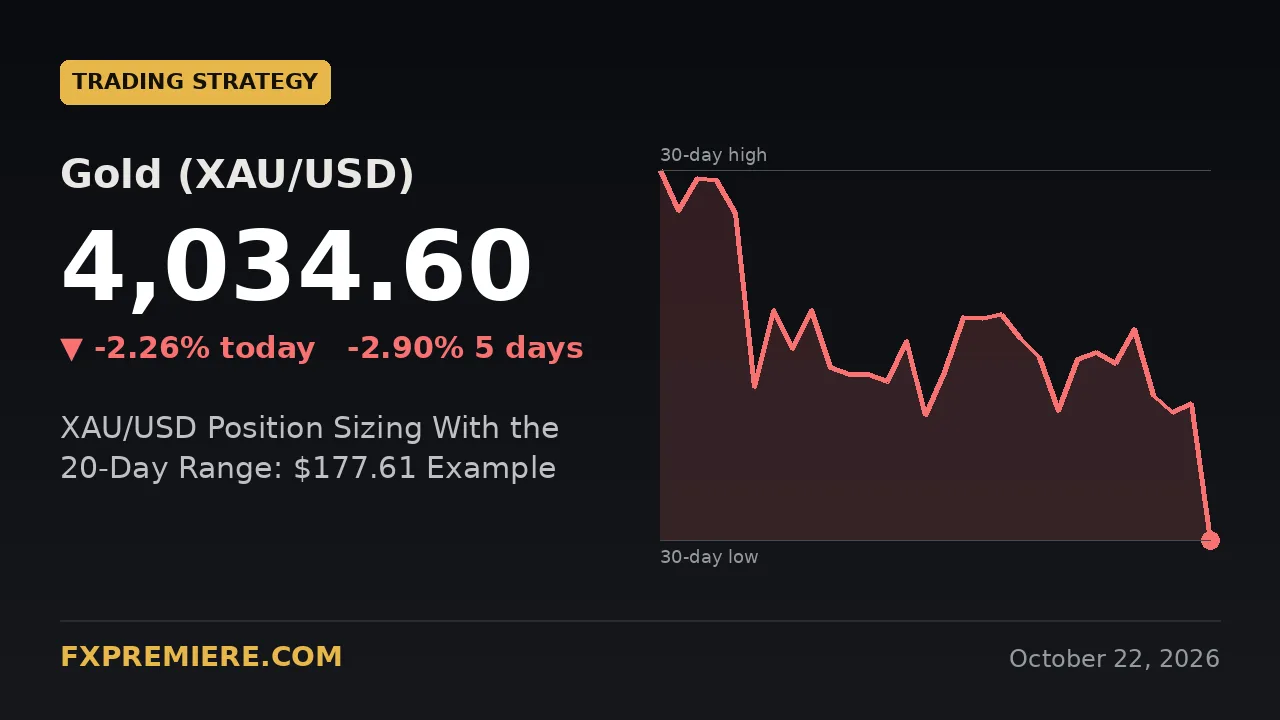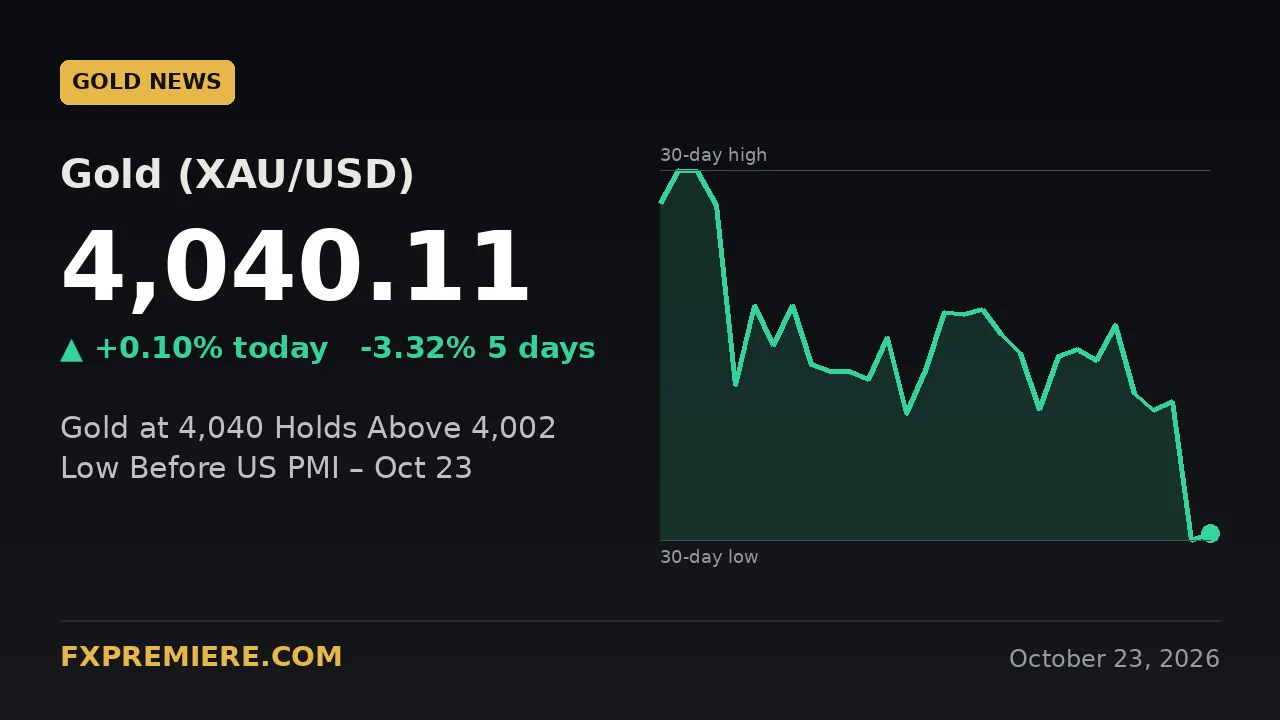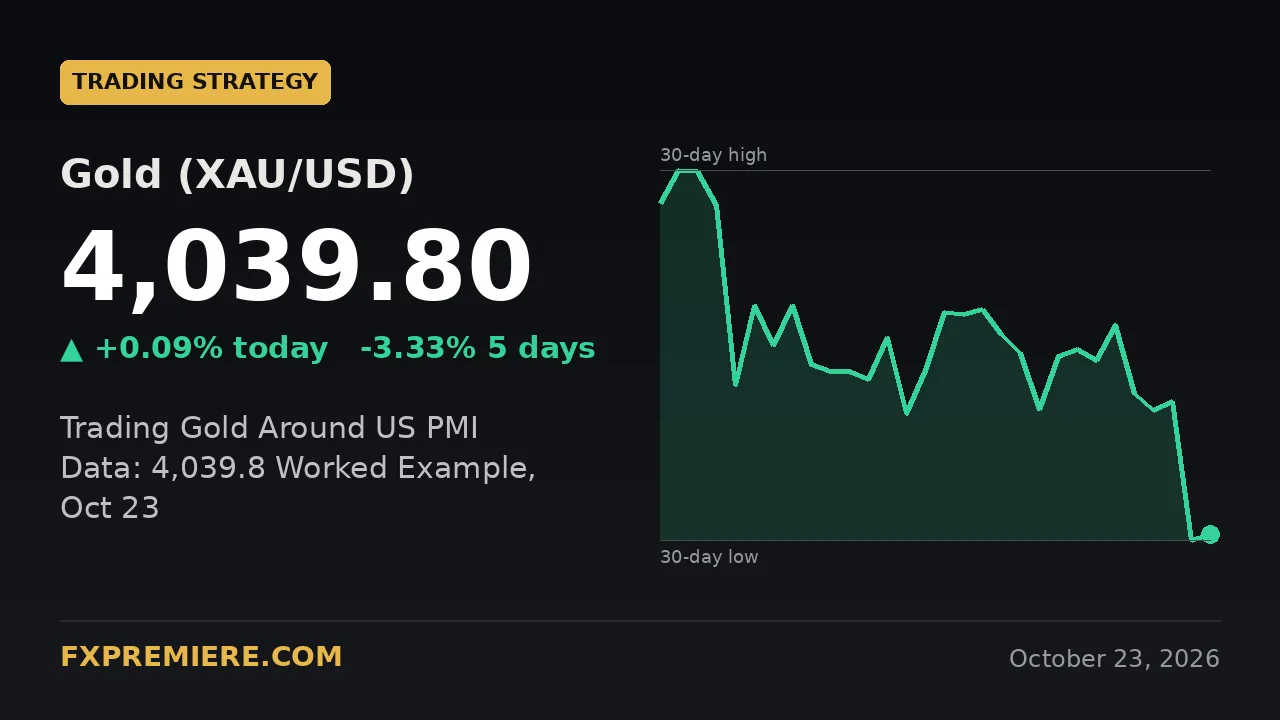
The safest way to trade around high-impact news is to decide your plan before the release: know the time, measure normal volatility, and size the position for a wider stop. Gold (XAU/USD) is at 4,039.8 this morning, 37.8 above its 20-day low of 4,002.0, with US flash PMIs due at 13:45 UTC. That makes today a useful worked example.
Key figures
| Instrument | Last | Daily change | 20-day high | 20-day low | 20-day average |
|---|---|---|---|---|---|
| Gold (XAU/USD) | 4,039.8 | +3.7 (+0.09%) | 4,211.15 | 4,002.0 | 4,143.19 |
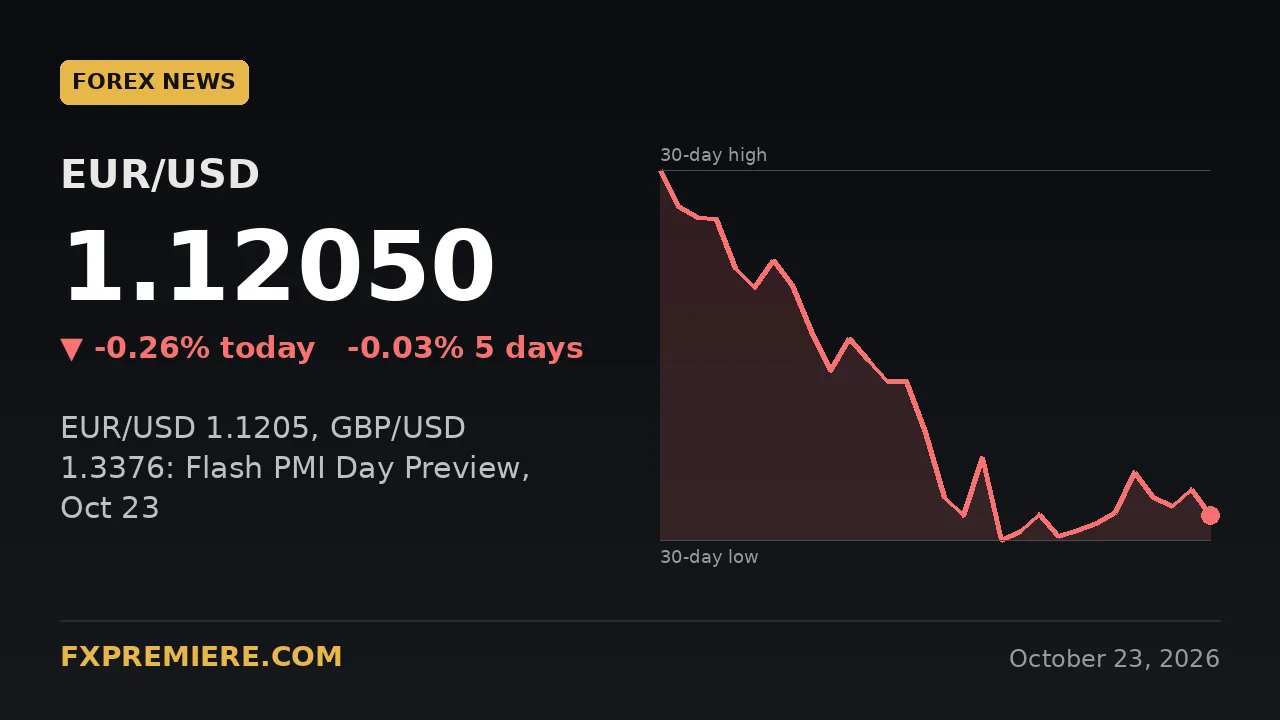
| EUR/USD | 1.1205 | -0.0029 (-0.26%) | 1.1403 | 1.1177 | 1.1248 |
The EUR/USD figures are from the latest daily reference, dated 22 October. Gold is live as of this morning. Gold is down 3.33% on the week.
Why does trading around news need its own plan?
Scheduled data can move price faster than usual, and spreads often widen at the same moment. A stop that works on a quiet afternoon may be too tight at 13:45 UTC.
Many traders lose money on news days because they apply a normal-day plan to abnormal conditions. A news plan has three parts: what you know before the release, what you do during it, and what you wait for afterwards. The steps below build that plan.
How do you measure normal volatility before a release?
Start with the ranges you already have. Gold's range so far today is 42.09 (4,002.0 to 4,044.09). Its 20-day range is 209.15 (4,211.15 to 4,002.0).
- Today's range: this is the scale of an ordinary move on a day with several data releases already behind us.
- Distance to the average: gold is 103.39 below its 20-day average of 4,143.19, so price is stretched to the downside compared with the past month.
- Position in the range: at 4,039.8, gold is about 90% of the way up today's range, close to the 4,044.09 high.
For EUR/USD the 20-day range is 0.0226 (226 pips). The latest 1.1205 is 0.0028 above the 20-day low of 1.1177, so a small move would test that floor.
These numbers do not predict direction. They tell you how large a move is normal, which is the input you need for stop distance.
How should you read forecast versus previous?
Compare the forecast with the previous figure, because markets tend to react to the surprise rather than the number itself. A reading that matches the forecast often produces less reaction than one that misses it clearly.
Take the US flash Manufacturing PMI today: forecast 55.4 against a previous 57.0. The forecast already assumes a slowdown, so the data would have to differ from 55.4 to be a surprise. The same logic applies to Services, forecast 57.9 against 58.7.
For gold, the usual link is through the dollar and yields, which is covered in our guide to the macroeconomic drivers of gold. A stronger-than-forecast US print could support the dollar and weigh on gold. A weaker one could do the opposite. That relationship is not guaranteed on any single release.
How do you set a stop and size for a news window?
Size the stop to the volatility, then size the position to the stop. Here is a hypothetical example, not a trade idea.
- Fix your risk. Suppose you risk $100 on a trade, in line with the 1% to 2% rule.
- Choose the stop from structure and noise. A stop of 20 points inside a 42.09 daily range may sit within normal noise. A stop of 40 points is roughly one full day's range.
- Divide risk by stop. With $100 at risk, a 20-point stop allows about 5 ounces. A 40-point stop allows about 2.5 ounces.
Doubling the stop halves the size, and the dollar risk stays the same. For a fuller treatment, see the guide to gold position sizing.
Three ways to handle the release itself
- Stand aside: close or avoid positions until the first burst of movement settles.
- Reduce size: keep a position but cut it so a wider stop costs the same.
- Wait for confirmation: let the first candles pass, then see whether price holds above or below a level such as 4,002.0. A close below it would put gold at a fresh 20-day low. A hold above it would keep the recent range intact.
What is on the calendar today?
The European and UK releases are already past. The US releases are still to come, and these are the ones most likely to affect gold and EUR/USD in the afternoon session.
- 06:00 UTC, GBP Retail Sales m/m: forecast -0.1%, previous 0.5%.
- 07:15 UTC, French Flash Manufacturing PMI: forecast 50.5, previous 50.3.
- 07:15 UTC, French Flash Services PMI: forecast 50.7, previous 51.4.
- 07:30 UTC, German Flash Manufacturing PMI: forecast 53.5, previous 53.8.
- 07:30 UTC, German Flash Services PMI: forecast 52.5, previous 52.9.
- 08:30 UTC, UK Flash Manufacturing PMI: forecast 51.8, previous 52.0.
- 08:30 UTC, UK Flash Services PMI: forecast 51.8, previous 51.7.
- 13:45 UTC, US Flash Manufacturing PMI: forecast 55.4, previous 57.0.
- 13:45 UTC, US Flash Services PMI: forecast 57.9, previous 58.7.
- 14:00 UTC, Revised UoM Consumer Sentiment: forecast 46.3, previous 46.3.
- 14:00 UTC, Revised UoM Inflation Expectations: no forecast given, previous 4.7%.
Check the actual European prints against the forecasts above, since they may already have shaped the euro this morning. The 13:45 to 14:00 UTC window brings three US releases within 15 minutes, so expect a crowded, fast period. Session timing is explored further in our piece on the London open and New York crossover.
Frequently asked questions
Should I trade during high-impact news?
It is a personal choice, and many traders prefer to wait until the first reaction has settled. If you do trade it, use a smaller size and a stop based on current volatility, not your usual one.
Why does a smaller position help on news days?
Moves can be larger and spreads wider, so stops often need more room. A smaller size keeps the money at risk the same even when the stop distance grows.
Where can I follow gold levels during the day?
Our gold signals page shows how levels are shared with subscribers, and the Forex Signals Strategies section collects more step-by-step guides like this one.
Trading involves risk, and you can lose more than you expect, especially around news releases. The levels and examples above, including the hypothetical position sizes, are for education only and are not investment advice.
Risk warning: trading gold, forex, CFDs, indices and crypto involves significant risk of loss. Signals are educational information, not personal financial advice, and past results do not guarantee future performance. FXPremiere is a signal provider, not a broker.