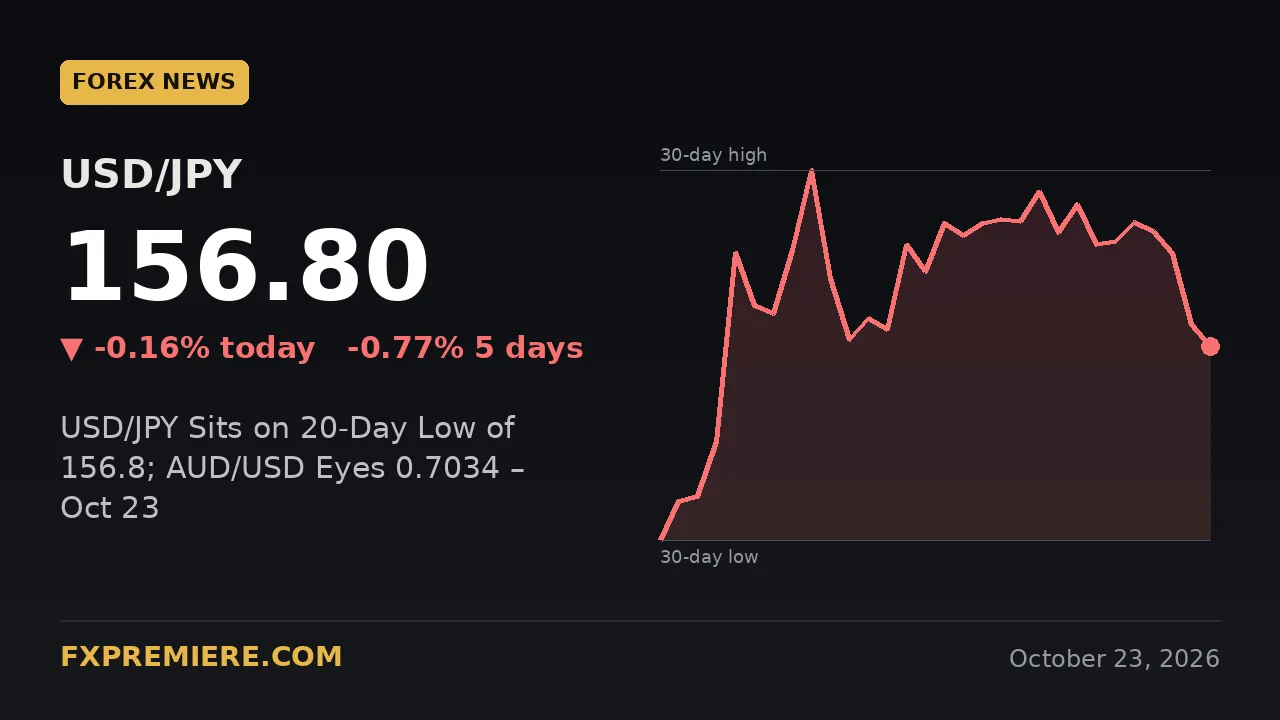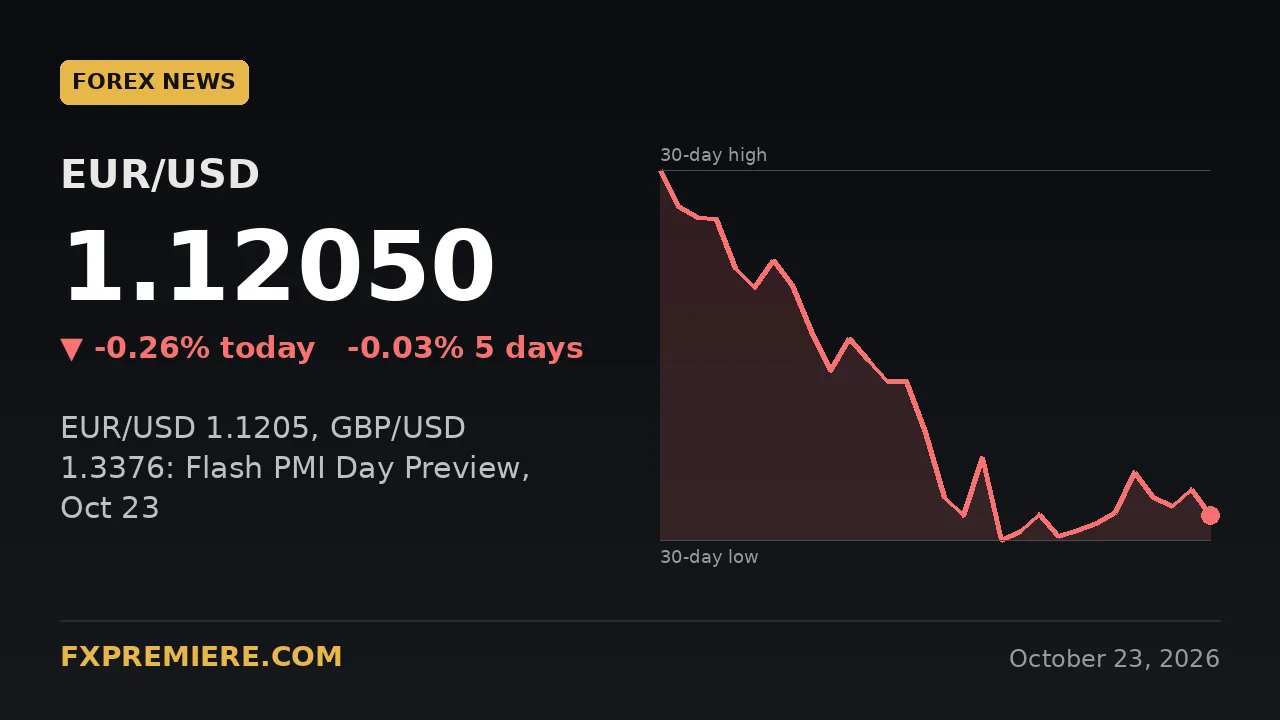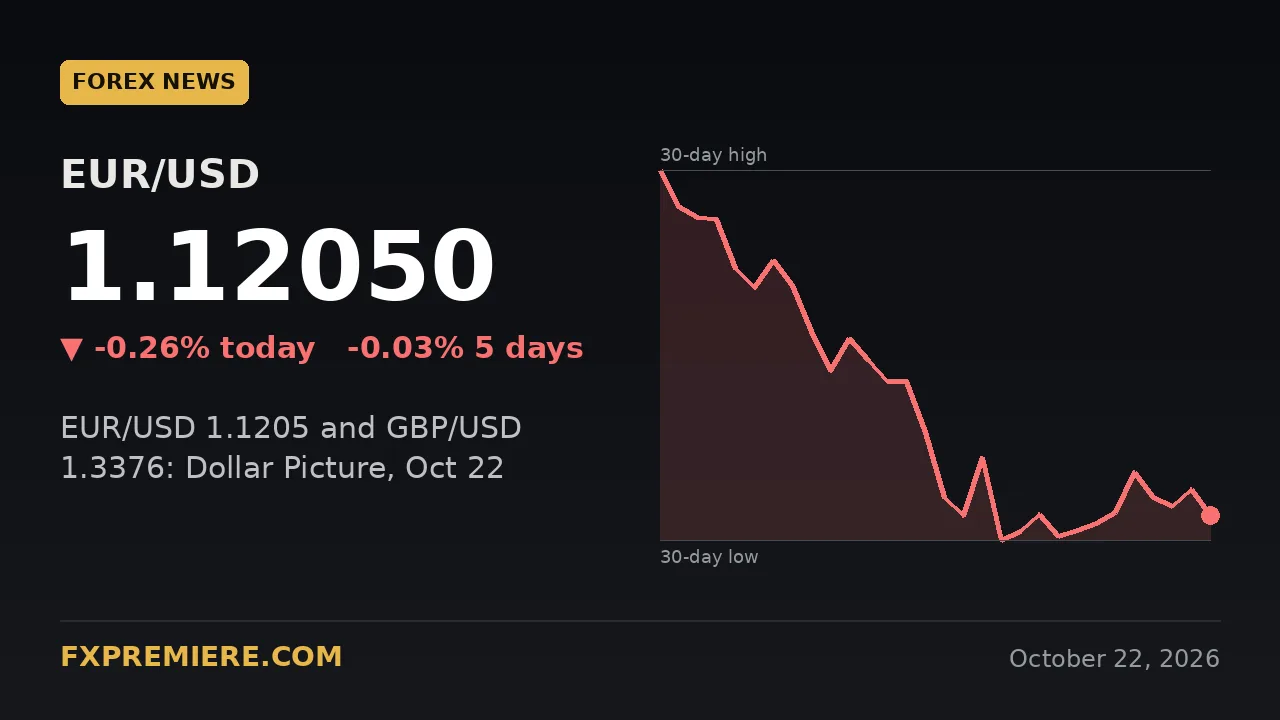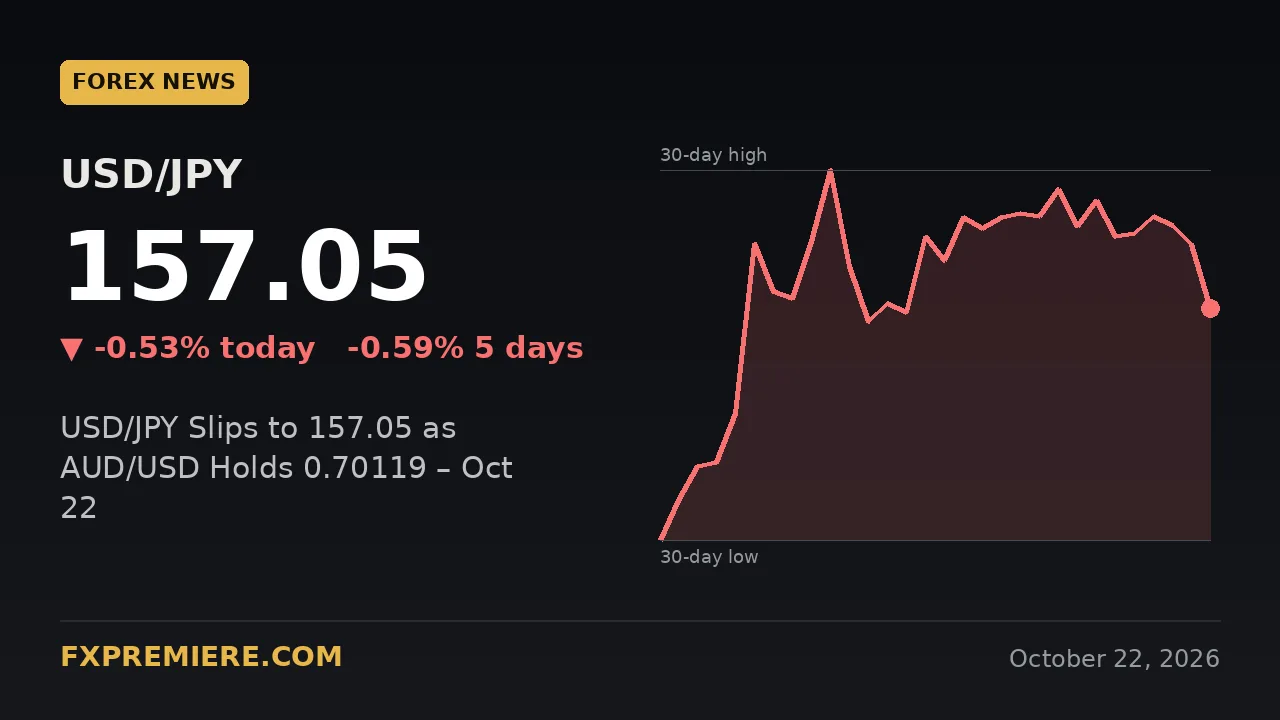
USD/JPY is trading at 157.05, down 0.83 (-0.53%) from the previous close and only 0.17 above its 20-day low of 156.88. AUD/USD has eased 0.31% to 0.70119, but it remains 1.46% higher on the week. With the main sessions of the day largely behind us, the focus now shifts to Friday's flash PMIs.
The figures below come from the latest daily reading for 22 October. They show where each pair sits against its recent range, not an intraday high and low.
Key figures
| Pair | Last | Change | Change % | 20-day high | 20-day low | 20-day average |
|---|---|---|---|---|---|---|
| USD/JPY | 157.05 | -0.83 | -0.53% | 158.6 | 156.88 | 157.889 |
| AUD/USD | 0.70119 | -0.00221 | -0.31% | 0.7034 | 0.69108 | 0.69791 |
| USD/CAD | 1.4034 | -0.0012 | -0.09% | 1.4262 | 1.4034 | 1.41848 |
| USD/CHF | 0.82204 | -0.00189 | -0.23% | 0.83528 | 0.82204 | 0.82982 |
Why is USD/JPY lower today?
USD/JPY is lower because the dollar has lost ground against the yen, with the pair down 0.53% on the day and 0.59% on the week. The data does not say what drove the move, so it is better to read the position than to guess at a cause.
- The pair is 0.839 below its 20-day average of 157.889, so it has slipped under its recent centre of gravity.
- It sits 1.55 below the 20-day high of 158.6.
- It is just 0.17 above the 20-day low of 156.88.
A daily close below 156.88 would put the pair at a new 20-day low and could invite a further test lower. A rebound back above the 157.889 average would suggest the dip is fading.
How do US yields link to USD/JPY?
USD/JPY often follows the gap between US and Japanese interest rates, so moves in US Treasury yields can spill into the pair. When US yields rise, the dollar tends to gain against the yen. When they ease, the pair often softens.
We do not have yield figures in today's data, so we cannot confirm that yields explain the 0.53% drop. What we can say is that a lower USD/JPY fits a softer dollar tone, and that US yields are the first thing to check alongside the pair. Our guide to the macro drivers of real yields and the dollar index explains why the same link matters for gold.
What are the key AUD/USD levels to watch?
The key AUD/USD levels are 0.7034 above and 0.69791 below. The 0.7034 level is both the 20-day high and the previous close, so the pair is 0.00221 beneath it after today's dip.
- Resistance: 0.7034. A close above it would mark a new 20-day high.
- Support: the 20-day average at 0.69791, which is 0.00328 below the current price.
- Deeper support: the 20-day low at 0.69108, which is 0.01011 below.
A weekly gain of 1.46% is a strong move for a major pair. Today's 0.31% pullback looks like a pause within that advance, but a close back under 0.69791 would weaken that reading.
Is the dollar weaker across the majors?
The dollar is lower against all four pairs here today, but the moves are uneven, so it is not a uniform sell-off. USD/JPY fell 0.53%, USD/CHF 0.23% and USD/CAD 0.09%. AUD/USD also fell 0.31%, which means the Australian dollar lost ground against the US dollar even as the dollar slipped elsewhere.
The weekly picture leans more clearly toward dollar softness:
- USD/CAD is down 1.22% on the week and at its 20-day low of 1.4034.
- USD/CHF is down 0.98% on the week and at its 20-day low of 0.82204.
- USD/JPY is down 0.59% on the week and near its low.
When several pairs print their lows together, a single data release can move them all, so Friday's US data deserves attention. Our piece on the London open and New York crossover covers why liquidity matters at those times.
What is on the calendar next?
The next high-impact data arrives on Friday 23 October, starting in the UK morning. Thursday's US unemployment claims were due at 12:30 UTC (forecast 200K, previous 199K), but no result is in our data, so check the release itself.
- 06:00 UTC, GBP Retail Sales m/m: forecast -0.1%, previous 0.5%.
- 07:15 UTC, French flash PMIs: manufacturing forecast 50.5 (previous 50.3); services forecast 50.7 (previous 51.4).
- 07:30 UTC, German flash PMIs: manufacturing forecast 53.5 (previous 53.8); services forecast 52.5 (previous 52.9).
- 08:30 UTC, UK flash PMIs: manufacturing forecast 51.8 (previous 52.0); services forecast 51.8 (previous 51.7).
- 13:45 UTC, US flash PMIs: manufacturing forecast 55.4 (previous 57.0); services forecast 57.9 (previous 58.7).
- 14:00 UTC, revised UoM Consumer Sentiment: forecast 46.3, previous 46.3.
- 14:00 UTC, revised UoM Inflation Expectations: previous 4.7%, no forecast given.
The US releases matter most for USD/JPY, AUD/USD, USD/CAD and USD/CHF. Both US PMI forecasts sit below their previous readings, so a result above forecast could lend the dollar support, while a miss could add to the recent softness. The inflation expectations figure may also feed into the yield debate. The calendar lists no yen or Australian dollar events, so those two pairs may take their cue from the US data and from the Asian session open.
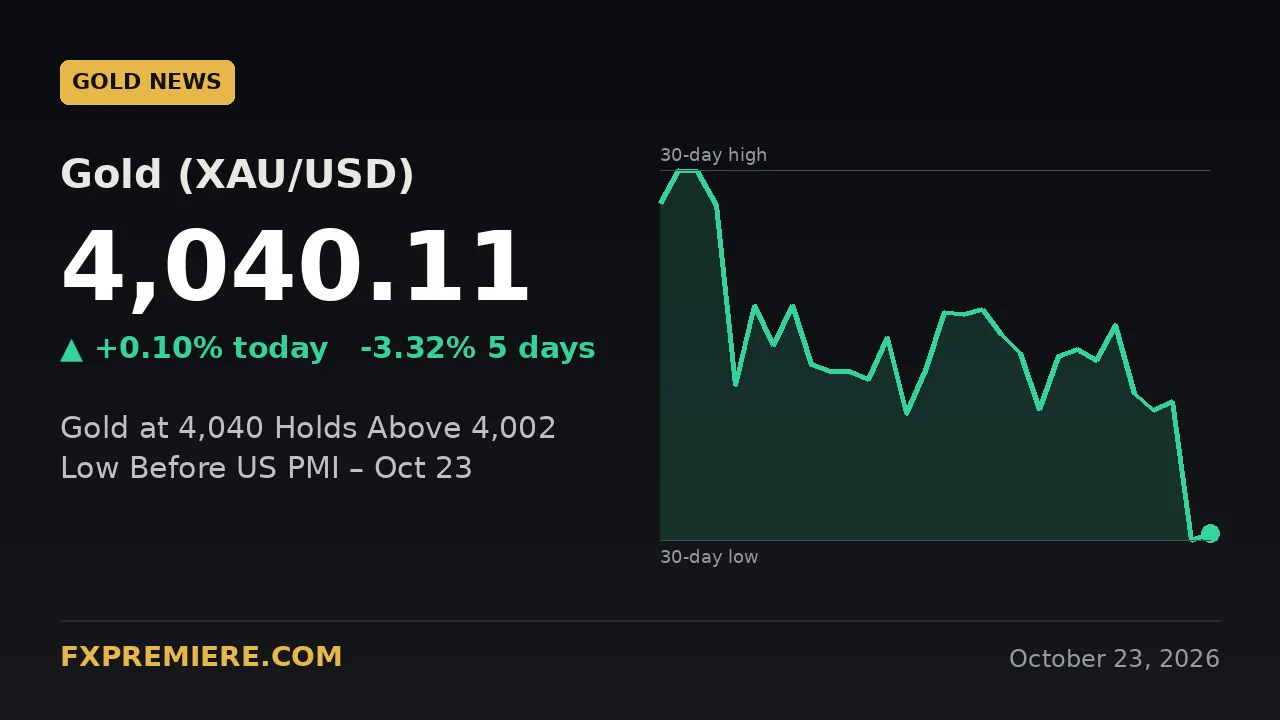
For a wider view, see our live forex news page. Gold traders can also read how to read XAUUSD signals before acting on any dollar-driven move.
Frequently asked questions
Where is USD/JPY trading today?
USD/JPY is at 157.05, down 0.83 or 0.53% from the previous close of 157.88. Its 20-day range runs from 156.88 to 158.6.
Is AUD/USD still near its recent high?
Yes. At 0.70119 it is 0.00221 below its 20-day high of 0.7034 and up 1.46% on the week. It is also well above the 20-day average of 0.69791.
Which data could move the dollar next?
The US flash PMIs at 13:45 UTC and the revised UoM surveys at 14:00 UTC on Friday are the main scheduled risks. Forecasts are 55.4 for manufacturing and 57.9 for services. Both are below their previous readings.
Trading involves risk, and you can lose more than you expect. The levels in this article are for education only and are not financial advice. Always size positions to your own risk limits; our guide to risk management is a good place to start.
Risk warning: trading gold, forex, CFDs, indices and crypto involves significant risk of loss. Signals are educational information, not personal financial advice, and past results do not guarantee future performance. FXPremiere is a signal provider, not a broker.